Girl's eyes and four cards

PRE – FLOP POKER TELLS: PART ONE

In movies the key to winning at poker often is reading your opponent’s body language.  “I don’t need to look at my hand, I saw you look at yours.”  While you can’t make a living solely by noticing when a player reaches for his Oreos after he bets, every piece of information helps.  And there is a surprising amount of information available from watching the other players even after you fold, especially in No Limit Texas Hold Em

How Can I Read Hands in Poker Pre-Flop

You can start with whether the player seems comfortable or uneasy. Are their body and eyes relaxed or does the player seem stiff? Then see if you can find patterns in other players’ behavior, and notice when they deviate from those patterns. What did they do differently and why? Where are they looking? Be careful as well to distinguish how they act when the action is on them, while they are waiting for action and after they act. The same behavior may mean different things in each instance.

What are specific things to look for?   Well start before the flop by watching other people look at their cards.  How long does the player look at their cards?  Players that see two Aces tend to keep their hand close to the table and put their hand back down quickly.  There is an almost instinctive fear that other people may see their cards.  Players looking at hands closer to the bottom of their opening range may lift their cards higher and perhaps look at them a split second longer.

Notice what the player does after they put their cards down.  If the player looks at or touches their chips, that may mean they intend to play that hand.  Notice how they look at or touch their chips.  See if you can discern a pattern correlated to when they raise or call.  

And definitely look to your left.  The information about what people may do after you act is potentially more valuable since the players to your right will have acted before you.  Notice if any of the players look at their hands before it’s their turn to act.  If so, then watch them do so whenever you can.  If you see that a player to your left is likely to call, you may want to play your drawing hand and see if there is a multi way pot, or raise to chase them out.  If you see they are going to raise, you may want to tighten your range.  If on the other hand, you can tell they are going to throw away their hand, you might play more aggressively. 

These are a few basic concepts pre-flop.  In the next part, we’ll talk about other things to pay attention to after the flop.

Bay Area poker players love the California Grand Casino. We have the best poker and the liveliest action in all of Northern California. For seven years in a row, the California Grand has been voted “Best Casino in the East Bay” and “Best local Gaming in the East Bay” by the readers of the Bay Area News Group, which includes the San Jose Mercury News, the East Bay Times, the Marin Independent Journal and bayarea.com.  That is why they call it Hot Action Poker.™

Our Bay Area casino is open 24 hours a day, 365 days a year with fast paced Hold’Em and casino game action. We focus on what everyone wants: great games and service. Our staff is friendly and experienced, and as a result our poker games here are considered by many to be the best and with the most action in the Bay Area.

Table with chips in the casino

TEXAS HOLD’EM: CHECK-RAISING IN POKER WITH NOTHING … REALLY?


Often when you are out of position and check after the flop the player who took the lead pre-flop will bet into you.  You think “should I call or fold?”  One thing that separates good players from beginners is their willingness to take aggressive action when the situation warrants it.  You should consider also asking yourself  “should I raise” even if your hand doesn’t immediately warrant it.  You may end up raising as a bluff or semi-bluff.

Suppose pre-flop you are in early position with Q J of diamonds.  You limped or made a small raise pre-flop only to have a solid player in middle position raise or re-raise, which you called.  You go into the flop heads up.  When the flop comes 10, 8, 4 rainbow with one diamond, you have a backdoor flush draw, a straight draw and two overcards.  You check. 

The pre-flop raiser bets and you think you are behind but before folding you pause to consider the odds of calling to see if one of your draws improves.  At first, you don’t think about raising.   But as you start to put your opponent on a hand, you consider whether his bet is a continuation bet with overcards (probably stronger overcards than yours) or whether he is protecting a pair or better.  You know that pairs are less common for starting hands than his other possible hands, like AK – AJ, all of which missed the flop.  Even if he has a pair it might be an under pair and the 10 on the flop may make him nervous and ready to give up, although he may wonder why you didn’t bet it after the flop. Given how he has played, you think he probably did not raise with an unpaired 10 pre-flop so maybe it’s time to think about check-raising.

Check-raising is a very strong move in poker, and sends a clear message that you think you are ahead.  By check-raising you are putting a great deal of pressure on your opponent to decide whether continuing with the hand makes sense.  They have to consider not only the chips needed to call, but what may happen after the turn, when you possibly bet again.  You also have to consider your own table image in calculating the odds of whether they will believe your check-raise is strong and fold.  You will have to make the same calculations after the turn if they call your check-raise.  Of course, if you check-raise and get re-raised you will know where you stand.  In addition, if you do check-raise here and then give up your hand to a re-raise, next time you check-raise with a monster, you may get called or re-raised.

One thing to consider when check-raising as a bluff or semi-bluff is how much money you will have left in your stack after the raise.  You must be careful check-raising when short-stacked.  Without the threat of more bets to come your bluff will be less powerful, and you may find yourself committed to the pot with a marginal hand.

So while in most cases I would fold in this situation and not continue to play this hand out of position, if you think you have a good read on your opponent, check-raising can be the right move.

California Grand Casino poker table showing a winning hand of Ace and King with chips and community cards during a Texas Hold'em game

ADVANCED PAI GOW POKER STRATEGIES

Our Pai Gow (Double-Hand) Poker game is fun and exciting to play.  In our Bay Area Pai Gow Poker game, the Joker is fully wild — it can be any card — and can be used to make any hand, not just as an Ace or to complete straights or flushes, giving you more ways to make a winning hand.  You can also wager on the Dealer hand and have the advantage of playing against all the other players.

PAI GOW POKER IS A VERY SIMPLE GAME TO LEARN AND PLAY.

You separate your 7 cards into a 2-card and a 5-card poker hand. Your 5-card hand must outrank your 2-card hand. Your 2-card hand plays against the Dealer 2-card hand and your 5-card hand plays against the Dealer 5-card hand. The object of the game is to set your hands so that both your hands defeat both the Dealer’s hands.  The hands are ranked using standard poker hand rankings, i.e., straight flushes, 4 of a kind, a full house, flush, straight, two pair etc…

If both your hands rank higher than the Dealer’s two hands, you win. If you win one hand and the Dealer wins one hand, you push, which happens about 40% of the time.  If the Dealer wins both hands, the Dealer wins. It’s that easy!  

The Dealer wins any 2 or 5-card hands that tie. This is a built-in advantage for the Dealer hand but at the California Grand Casino every player gets a chance to bet on the Dealer hand.

SETTING THE HANDS.

You are often dealt hands that can be set in different ways. If you want to increase the odds of a push, you might set one hand very strong and the other weaker, or you might try to balance your hands in order to win both. The most common decision you make is when you are dealt two pair.  When should you put both pair in the 5-card hand, and when should you split the pairs and put one in each hand?  In addition, since we play with a fully wild Joker, how does that change how you set your hands?

Don’t want to set your hand?  We can set it “house way.”

At the California Grand Casino, you also can ask the house dealer how to set your hand the house way and you will stay almost even playing this way.  The Dealer hand is always set house way, but the player betting on the Dealer hand can reset the hand another way. 

Setting Your Hands: Both Hands are Equally Important

If you set your own hands, because you need both hands to win in order to win your wager, you should never neglect your 2-card hand.  A simple rule to remember is that ideally you would like to have an Ace high or better in your 2-card hand.  And you would like at least of pair of 7s in your 5-card hand. 

Here are a few specific situations, including advice on how to play your Joker.  At any time you can ask the dealer for advice.

  • Five of a Kind. Put the Joker with the highest single card in the 2-card hand, and keep four of a kind in the 5-card hand.
  • Four of a Kind (with a Joker). If these are fives or lower, keep them together. Otherwise put the Joker with the highest single card in the 2-card hand, and keep three of a kind in the 5-card hand.
  • Four of a Kind (No Joker). Keep them together if these are fives or lower. If you have an Ace or King to put in the 2-card hand, you can also keep nines and higher together, except if these are Queens or better, in which case you are usually better off splitting them.
  • Full House. Put your highest possible pair in the 2-card hand and three of a kind in the 5-card hand. If you have four of a kind and a pair or three of a kind and two pair, put the three of a kind, full house or four of a kind in the 5-card hand.
  • Flush or Straight. Keep your flush or straight together, unless you also have two pairs or three of a kind, in which case you should follow the rules for three of a kind or two pairs. If you have one pair, keep the flush or straight in the 5-card hand and split the pair.
  • If you have a six or seven card flush or straight, put the lower cards that make the flush or straight in your 5-card hand and the highest cards in the 2-card hand.
  • If you need your Joker for the straight or flush, put the two highest cards in the 2-card hand that will still leave a flush or straight in the 5-card hand. If you make the straight or flush without the Joker, use the Joker to make the highest possible pair in the 2-card hand and keep the flush or straight in the 5-card hand.
  • Three of a Kind. Keep them in the 5-card hand unless they are Aces in which case you put a pair in your 5-card hand and one Ace in the 2-card hand. If you have a Joker, play your Joker with the highest other card in the 2-card hand. If you also have a straight or flush, then put that in the 5-card hand and a pair in the 2-card hand.
  • Three Pairs. If you get three pairs, the best pair should be used for the 2-card hand and the other two pairs should be in the 5-card hand. If you also have a Joker, keep it with the 5-card hand to make a full house.
  • Pair. Put the pair in the 5-card hand and the highest two other cards in the 2-card hand. If you are using a Joker to make a pair, play the first and third highest cards in the 2-card hand and use the Joker with the second highest card to make a pair for the 5-card hand. If you have a natural pair and a Joker, match the Joker with the highest other card and follow the guidelines for two pair.
  • Pai Gow / No Pair. If you do not have a pair or better, put the highest card in your 5-card hand and the second and third best cards in your 2-card hand.

Setting Two Pairs.

There are several ways to play two pairs depending on whether you are trying to push or win.

  • House Way.  If the highest pair is AA, KK or QQ, place that in the 5-card hand and the other pair in the 2-card hand.  If the highest pair is JJ, 10s or 9s, split them unless you can put an Ace in the 2-card hand.  If the highest pair is 8s, 7s or 6s, split them unless you can put an Ace or King in the 2-card hand.  If the highest pair is 5s, 4s or 3s, split them unless you can put an Ace, King or Queen in the 2-card hand. 
  • Another method is to make the 5-card hand stronger.  For example, when your second pair is deuces, you may want to keep your two pair together and play the two highest remaining cards in the low hand.
  • Some people want a stronger 2-card hand  and they will split two pairs unless the highest pair is 77 or less and you cannot put an Ace in the 2-card hand. 

However you choose to play your hands, we are here to have fun.  You can always ask the house dealer for advice.  And you can always make friends and enjoy the camaraderie at our Pai Gow game, along with great food and service right at the table. 

Our Bay Area casino is open 24 hours a day, 365 days a year with Pai Gow and fast paced Hold’Em and casino game action. We focus on what everyone wants: great games and service. Our staff is friendly and experienced, and as a result our poker games here are considered by many to be the best and with the most action in the Bay Area.

How to play EZ Baccarat

What is EZ Baccarat?:

Baccarat is one of the most popular table games in American Casinos, and the undisputed king in Macau. Many variations of the game exist worldwide, varying by region. At the California Grand Casino we play EZ Baccarat, a variant popular in all of California and the East Bay and all across San Francisco Bay area. Here is our California Grand Casino game strategy on how to play EZ Baccarat.

How to play EZ Baccarat:

As the name implies EZ Baccarat is fast and easy to play.

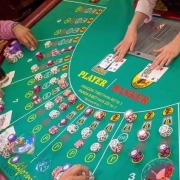
  • There are 2 hands: the Player and the Banker.
  • The dealer deals 2 cards for each hand. Depending on the initial card values, each hand may also be dealt a third card.
  • You bet on which hand will end up with a point value closest to nine (9).
  • You add up the cards in each hand and count only the last digit. So a 19 is a 9.

Betting:

You can wager on either the Player or the Banker hand having the highest total, or you can wager on a tie. A Player or Banker wager pays even money. A tie wager wins 9:1. EZ Baccarat plays like traditional Baccarat but eliminates the 5% commission on winning Banker hand wagers by making the hand a push when the Banker hand wins with a three card seven.

Bonus Wagers:

  • Dragon 7: this bet is won if a banker hand wins with a 3 card 7. The pay-out is 40:1.
  • Panda 8:  this bet is won if a player hand wins with a 3 card 8. The Pay-out is 25:1.
  • Tie:  this bet is won when the banker and the player hands reach a tie. The pay-out is 9:1


Our Bay Area casino is open 24 hours a day, 365 days a year with Baccarat and fast paced Hold’Em and casino game action. We focus on what everyone wants: great games and service. Our staff is friendly and experienced, and as a result our poker games here are considered by many to be the best and with the most action in the Bay Area.

Player Tips #2

A Poker Life – Part 2

A Poker Life At California Grand Casino – Part 2

Hey everyone glad to have you back for the second installment of my journey from learning how to play poker to being one of the many familiar faces at the California Grand Casino in San Francisco’s East Bay! In Part 1 of Poker Life At The California Grand Casino I told you about matching wits with my Grandma and playing with fraternity brothers and opponents more than double my age. The final chapter that sent me towards a life on the felt begins with an unlucky break in the most literal sense of the word.

New Year’s Eve: Dec. 31 1999. Massive New Year’s Eve celebrations abound Y2K fears unrealized and lots of uncertainty in the air as we slowly began to assimilate and embrace the new millenium-2000 here we come! But just prior to the New Year’s Eve festivities I finally made the very tough decision to drop out of college in Colorado and return home to California. This particular new year-2000-marked a completely new journey with no guarantees except that I would be living life on my terms. I had no idea where life was going to lead me but I was determined to enjoy the ride!

As it turned out that ride led me to a very rewarding environmental job that allowed me to travel a great deal. As I worked up and down the California coast I would take time in the evenings to find the closest local cardroom and play some poker. Every time I headed out of town for work you could find me at the local poker tables. I gained a great deal of experience during my time with this new job but it didn’t last long. The company lost a large contract and had to lay off workers; I was a casualty. I struggled to find work with other companies getting hired and laid off two more times. Throughout this turbulent period of employment I had been playing more and more poker and playing it quite well. Eventually I was putting in 50+ hours a week with excellent results so I simply kept playing. Without ever intending to I had evolved into a professional poker player!

Being the sports nut that I am I played on many sports teams-both as a youth and young adult-one of them being a soccer team. During a particularly grueling match an opponent tried to slide tackle the ball away from me. He crashed into my knee my cleats stuck in the ground and everyone on the field heard a loud POP! I wasn’t sure at the time what exactly had happened but I knew it was serious. The MRI at the hospital confirmed what I had feared: I had torn my ACL. I had to undergo two surgeries as a result of my injury and even with insurance it was far from cheap. My bankroll–the money I had been using to play poker and make a living–was now being diverted to repairing my knee.

Needing a new profession and not wanting to totally abandon my poker playing I naturally gravitated to the casinos. The California Grand was where I played the most. It had always been a friendly and enjoyable place to play. I liked the customers and the employees and the competition was challenging. My game continued to improve. I spent countless hours observing the dealers. The thought started to cross my mind that perhaps I could be a dealer. This could be an ideal profession for someone like me. Of course I had no prior experience working in a casino no dealing background and had not gone to dealing school-not exactly great credentials. What I did have was persistence and a deep understanding of the nuances of the game. After speaking with the general manager I was told to practice and come back for an audition. I practiced constantly, passed the audition, and began my career as a dealer in the East Bay with California Grand Casino. The rest is history. After dealing for several years I moved on to work as a tournament director dealer trainer and floorman before settling into my current role of prop player blog writer and utility employee. Life is unpredictable and you never know what seemingly innocuous event can end up changing your life forever. There have been many bumps and bruises along the way both literally and figuratively and I wouldn’t trade them for the world. Just like a day at the poker table life is unpredictable…might as well enjoy the ride!

Until next time see you at the tables!

learning the game #1

To Bluff or Not to Bluff!

To Bluff or Not to Bluff, That is the Question!

Welcome back my friends! I hope that you’re enjoying the change in seasons and the additional sunlight that comes with it. The season isn’t the only thing changing around here…when you have a moment, check out our brand new website! All the information you need is there, including our latest promotions, great offers, and current JACKPOTS!

Something I overheard at the tables the other day really caught my attention and caused me to think a great deal about the topic. A regular opponent of mine said, “You just can’t bluff in this game, no one throws away their hand!” It struck me for two reasons. First, I have successfully bluffed this particular person on several occasions (in LIMIT poker no less!) Secondly, while his perception is a common one, it simply isn’t true. It certainly has some credence to it, as bluffing in limit poker is no easy task, and not one I would often recommend. That being said, there is a time and a place for it, both in limit and in no-limit Hold ’em. It’s impossible to pin down exactly when you should or shouldn’t bluff, but there are a couple things that you want to keep in mind if you’re considering making a move.

Know your opponent(s)

If you’re going to attempt the most daring play in poker (outside of playing Omaha!), be sure to have a decent understanding of who you are trying to bluff. We all know the few players that simply never fold a hand like top pair or better. It just doesn’t happen and they want to see your hand no matter how badly they’re beaten. You see them make hopeless calls on the river all the time against other players. Despite knowing this, you may find yourself in a pot with this person on the river when you completely missed your hand. You will feel the urge to bet. After all, it’s the only way you can win now, and the pot is so big…what’s one more bet? You MUST fight that urge. Take a second, remind yourself of whom you’re playing against, and simply let this one go. Save that bet and live to fight another day.

Now take that same situation and replace Captain Calls-a-Lot, with Pondering Patrick. Patrick is a thinker at the table. He tries to make the best play and often gives his decisions a lot of thought. He prides himself on his solid play and isn’t shy about telling people about it. He might even show a fold face up just to impress the table with his hand reading ability and his knowledge. Here is your opportunity. Now that’s not to say that you go out of your way to bluff Patrick, but if you happen to find yourself in a situation like the one above and Patrick is your only opponent, a bluff just might be in order if other conditions are right. What other conditions? Glad you asked…

Know your situation

Simply put, your bluff needs to make sense in order for it to have the best chance of working. If you haven’t been taking any aggressive action when other people have shown weakness, and now at the end of the hand you bluff trying to represent top pair, you’re going to have a tough time. Especially against more observant players, you want to make sure that your bet/bluff AND your previous actions in the hand are along the lines of what someone would expect you to do if you had the hand you are trying to represent. This advice is especially important in no-limit. When your actions are inconsistent and things don’t make sense to your opponent, they are far more likely to call your bet. This advice also applies when you are facing a potential bluff. Think back through the hand. Does your opponent’s play make sense? If something doesn’t quite add up, chances are a call is in order.

If you find yourself considering a bluff, be sure that you’ve thought about who your opponent(s) are and if your previous actions in the hand make sense. If both of those variable are favorable, then you may want to take a stab at it. If one or both of those factors are out of whack, you may be better served by waiting for a better spot. Don’t be afraid to go with your gut and put yourself (and your chips) out there! Until next time, see you at the tables!

learning the game #1

Rules, Rules, Rules

Rules, Rules, Rules..Know Them!

Happy New Year poker fans! I hope your 2014 was fruitful and you rang in 2015 in style!

I’m usually not a fan of New Years’ resolutions, but this is the perfect time to make a promise to yourself to improve your poker game. Many people are hesitant to spend time improving their game. Some of the most common reasons I hear include:

1. Not having enough time
2. Thinking that improving one’s game is only for serious players
3. I’m just a casual player so why bother?
4. Simply not knowing how to go about it

Well let me solve those for you right now. You’re reading this article so you do have enough time. Everyone can benefit from improving their game. I’m going to show you a simple way to improve poker game fundamentals that will make you a better player by the time you’re done reading this post. Do we have a deal? Good.

Here are three words that will make you a better, more skilled player:

KNOW YOUR RULES!

Well thanks a lot captain obvious, how is that going to make me a better player? Let me explain. Knowing your rules means a lot more than simply knowing the rules of poker. Poker is not a black and white game. Poker is almost entirely played in the gray area. We seldom have all the information we need to make the most informed strategic decisions when playing a game of poker. Situations change and your decisions change with them. Rules are no different. Have you ever taken the time to read the rules of the game at your local casino? Any good casino will have them readily available. The California Grand Casino has fliers with all of the games, rules, and information available at the side of the information desk, as well as official copies that are laminated and chained to the right side of the main cage. If you’ve taken a look, it can be a bit overwhelming. Rules and interpretations of those rules vary from casino to casino, and rules even change at the same casino over time. The price you pay for not knowing the rules specific to your game at your casino can be steep. You might get away with making an easily correctable mistake, or it may end up costing you your whole stack! Here are a few quick examples of the types of rules that can vary from casino to casino, that you want to make sure you know before you sit down at the table.

Raising/String Bets

This is important in Limit, and even more critical in No-Limit. The things you want to make sure you know are:

1. Is there a betting line and how is it used to enforce bets?
2. How much do you need to put in the pot for it to be considered a raise? (Limit: Half of a raise or more? No-Limit: all of the raise? A specific percent of the raise facing you?)
3. Are you allowed to declare raise and then put out the call first while maintaining your ability to raise whatever amount you want?
4. How many raises cap the action (Limit only)?
5. Is it the responsibility of the players or the dealer to call a string bet?

Seat Changes

Where you sit at the table in relation to the other players is extremely important. If you don’t know why, I wrote about it here. You need to know if there is a seat change list (and how it works), if there are seat change buttons, if players cut for a seat, or if it’s simply first to request it or lock it up. Don’t be shy, speak up and ask a dealer, floor-person, or even a regular player.

Lobbying

The last thing you want to do is lose your seat in a game or lose a couple chips because you aren’t clear about what the lobbying rules are. Some places take a lobbying fee from your stack. Some places allow you to miss three orbits (the button moving around the table and returning to the same spot is considered one orbit), while others give you a set time limit (ask the floor-person if you need longer and they may cut you some slack). Be sure to know how it works where you play.

Tournaments

Some rules are different in tournaments than they are in cash games. Find out before you sit down or it could cost you dearly. In some tournaments, if you are on your phone or not in your seat when the cards are dealt to you, your hand is dead. Don’t let that happen to you. Swearing and other unseemly behavior can cause you to miss an entire orbit or sit out for a period of time as a penalty. Thankfully you would never do such a thing, but just in case…I thought I’d mention it.

Knowing the rules of the game is such a simple thing and yet many people don’t take the extra time needed to make sure they understand how things work where they’re playing. Always ask someone about the rules when playing somewhere new and be sure that you know the rules inside and out wherever you play regularly. You’ll avoid costly mistakes and that helps improve your bottom line.

Until next time, see you at the tables!

Player Tips #2

Table Talk – When to Walk Away

Happy Holidays everyone! I hope you are staying warm and dry this season, as it sure has been cold and wet lately. The change in weather combined with people taking time off of work means that the action inside the California Grand Casino has been heating up! We’ve talked a lot about various aspects of poker strategy in the past, but something that doesn’t get covered very often is how to quit a poker game. How does a player know when it is time to get up from the table and call it a day? It’s not nearly as easy as it sounds. When do you quit when you are running well and winning pots? When do you quit when things aren’t going your way? The reasons vary from person to person, so there’s no single right answer I can give you. What I can tell you is that there are some factors to consider when deciding whether or not to get up from a poker game, and by taking a few moments to really consider your motivations and options, you should be able to figure out exactly what course of action is right for you.

In order to answer the question of when to walk away, you have to first establish why you started in the first place. Everyone starts because they want to play poker, but it goes beyond that. Why do you play poker? What motivated you to sit down at the poker table today? Let’s discuss a few of the main reasons that people play poker and when they should quit based on their individual motivations for playing.

Playing for fun

You love poker. You’re the type of player that plays to relax, unwind, socialize, and have a good time. You come after work to de-stress and sometimes come in on the weekends to enjoy some friendly competition. Poker to you is simply a fun game that provides recreation, interaction, and occasionally a little extra spending cash. When should you get up from the game? Get up from the game when the game ceases to be what you want it to be anymore. If you came to enjoy yourself and relax, and yet find yourself getting frustrated by bad beats or irritated by the chatterbox sitting to your left, then it’s time to take a break and consider cashing out. Maybe a break or a quick bite to eat is all you need and you can get back to enjoying the game. If not, then perhaps it’s time to end the session.

Another reason a recreational player may want to quit the game is when he or she simply has other responsibilities to attend to. If you are someone with a lot of things to take care of, I would suggest giving yourself a time limit and sticking to it. You can be a bit flexible if things are going extremely well and you’re having an absolute blast, but for the most part you should keep your promise to yourself and abide by your self imposed poker curfew.

Playing for keeps

You are a serious player. You’re competitive, better than most, and came to win. Don’t let others be fooled, you love a great time on the felt just as much as the next guy, but the chips are what brought you here and you plan to walk out with a ton! You work on your game and discuss strategy with your peers. You even read a small poker blog to see if there are any pearls of wisdom hidden among the verbosity! When should you get up from the game? That can be a bit of a trickier question than it is for a recreational player because there are factors outside of yourself to consider. Firstly, do you have the time to continue to play? If deciding to continue to play puts you on the clock and you’ll have to leave by a certain time, then it’s definitely best to call it a day. Playing with a fixed time limit looming can throw even the best players off of their A game. Speaking of playing your A game, that’s another reason to cash out. Any time you’re not playing your A game and you become aware of it, take a quick mental break. Ask yourself why you slipped from playing your A game and answer yourself honestly. If you can get back to the top of your game, then it’s safe to carry on. If other factors are contributing to your sub-par play such as being tired, tilted, or tense, then perhaps you would be best served heading to the cage.

As poker players there are so many things that we have little control over; our opponents’ actions, what cards will come, and any number of other variables in a card room. One of the few things we do have control over is when we get up from the game. A little bit of self reflection and honesty is all that is needed to help you arrive at the conclusion that’s right for you. Until next time, see you at the tables!

Player Tips #2

A Poker Life – Part 1

A Poker Life at California Grand Casino-Part 1

I hope your summer has been full of fun, adventure and huge pots! Mine sure has been.

Some of you have been asking me what it’s like being in my line of work…what a loaded question! I took some time recently to reflect on my growth and experiences in poker, and open up a bit about how I got my start, how things progressed, and some of the skills it takes to move your game from casual hobby to serious financial pursuit. In part one of this series I’ll share with you my personal poker journey, from a baby faced 21 year old, all the way to a casino employee with a poker blog…with several large bumps along the way.

The very first time I played cards competitively was not in a smoke filled Nevada casino or a friendly California card-room. I played heads up gin rummy against the most skilled player and most ruthless competitor I knew at the time. I was about 5 years old and at the mercy of my wonderful grandmother. While no money changed hands, score was meticulously kept and no punches were pulled. She never took it easy on me and she taught me the basics, as well as how to keep score. I owe her a great deal of gratitude for always playing to win, as I was forced to learn and develop skills in order to compete and improve.

My introduction to poker didn’t come until my college days. My fraternity brothers had a weekly game that they would play, mostly small tournaments, that drew my attention. I wasn’t the best player in the house when we first started playing, but by the end of my college days I was winning a great deal of free beer! My 21st birthday led to my first authentic casino poker experience at the now defunct Frontier casino on the Vegas strip. They had a grand total of two poker tables and I had the choice between seven card stud, or…seven card stud. Not a lot of choices and not exactly an environment that I was familiar with. Keep in mind this was back in 2001, a few years before the softening of poker’s image and the widespread acceptance that came along with the poker explosion fueled by Chris Moneymaker, PokerStars, and a booming economy. I was staring at a table full of cigarette smoke and players at least twice my age. Nevertheless I was very intrigued and sat down to play my first hand. I picked up the game quickly but must have looked like a complete rookie handling my chips and placing my bets. I didn’t leave the table with chips that day, but what I did leave with was an inner desire to play again. At the time I couldn’t figure out why, but now I understand completely what kept drawing me back to the poker table.

It may sound a bit corny, but what really appealed to me (and still does!) about poker is equality. Sure I love the competition, the strategy, and of course winning money, but the fact that everyone that sits down at the poker table is an equal is what I really love. Everyone at the poker table shares a common interest and there is an instant camaraderie that is formed. It doesn’t matter what culture you’re from, what native language you speak, how old you are…we’re all equals on the poker table. When you buy into a poker game, you’re instantly accepted. Obviously this should always be the case, but life doesn’t always work that way. Poker does.

It’s amazing how small events and accidental roads traveled can lead us down a certain path. Had my grandmother not introduced me to competitive card games at a young age, I may never have found my way to a game that has provided me with countless amazing experiences and a profession that I enjoy every day. Thank you grandma!

Part 2- Next time I’ll share how I went from novice player to semi-professional poker player (getting laid off from a job and blowing out a knee in a soccer match were big game changers!).

Until then, see you at the tables!

learning the game #1

Poker Table Etiquette – Part Two

Poker Table Etiquette – Part Two
I hope you have all been enjoying the summer and the hot weather that comes with it! It is by far my favorite season with all of the fun activities that can be done. When I need a break from the heat there’s nothing better than playing some poker in our nicely air conditioned cardroom here at the California Grand Casino. Relaxing. joking with familiar faces and dragging some pots always puts me in a great mood. You just can’t duplicate that feeling that you get at the poker table anywhere else; it’s why we play the game.

What doesn’t put me in a good mood is seeing players chastise and berate one another over perceived poor play. In my last blog posting Table Etiquette: The Flow Is Good For the Game we talked about appropriate etiquette at the tables,basic good manners and self-awareness. Today’s article takes that a step further.

It’s completely understandable to feel upset after suffering a bad beat but it’s not OK to verbally attack the player that put the beat on you. It makes that person uncomfortable and kills the mood at the table. We’re all here to have fun and win some pots but taking your frustrations out on another player accomplishes neither of those things. In fact it actually hurts your ability to do both. If you find yourself feeling the urge to let someone else know that they made a bad play at the poker table I have two techniques that will help you let go of that hostility and get your head back in the game where it belongs. I use these techniques all the time and have found them to be quite effective. Hopefully they will work for you too.

Inject Logic

Technique One: Inject logic. I use this phrase all the time. I use it at the poker table as well as in my everyday life outside the cardroom. There’s no hidden meaning here. The phrase means exactly what it says. When you encounter a situation at the table where your emotions seem to be getting the best of you use your mind to inject logic into the situation. Ask yourself What will I be accomplishing by giving this player a hard time? Don’t just stop at the question, answer it! One correct answer is you will be making the player feel bad and killing the mood at the table for everyone else. Another correct answer is that you are pointing out a mistake (or so you think) that your opponent made which may help him avoid making that same mistake in the future thereby improving his or her game and making it harder for you to win money off of them.

When you simply look at the facts it’s easy to see what the right decision is: Keep your thoughts to yourself and do your best to let it go. Not only does this help keep the game fun for everyone but it also keeps your head in the game and doesn’t help to improve your opponent’s play. I understand that this course of action is much easier said than done which brings me to my other point:

Know Thyself

Technique Two: Know Thyself. No one knows how you react at the poker table better than you. You know what triggers frustration and anger for you. You know how well or poorly you deal with it. You know what makes you tilt and play less than you’re A-game. I can give you all the advice in the world but it may not be perfect for you. Find out what is. If taking a break from the table for a bit helps you get back on track do it. If you feel you need to stay at the table and muscle through it do it. If you need to vent to feel better do it-but not AT the table!

The bottom line is: the only person that knows how you tick and what truly works for you is you. Understand where your strengths and weaknesses lie and manage them accordingly. By keeping your emotions in check everyone will have a friendlier game and your own poker game will improve.

Until next time see you at the tables!